

Cooling Down: CCF Tea for the Late Summer Transition
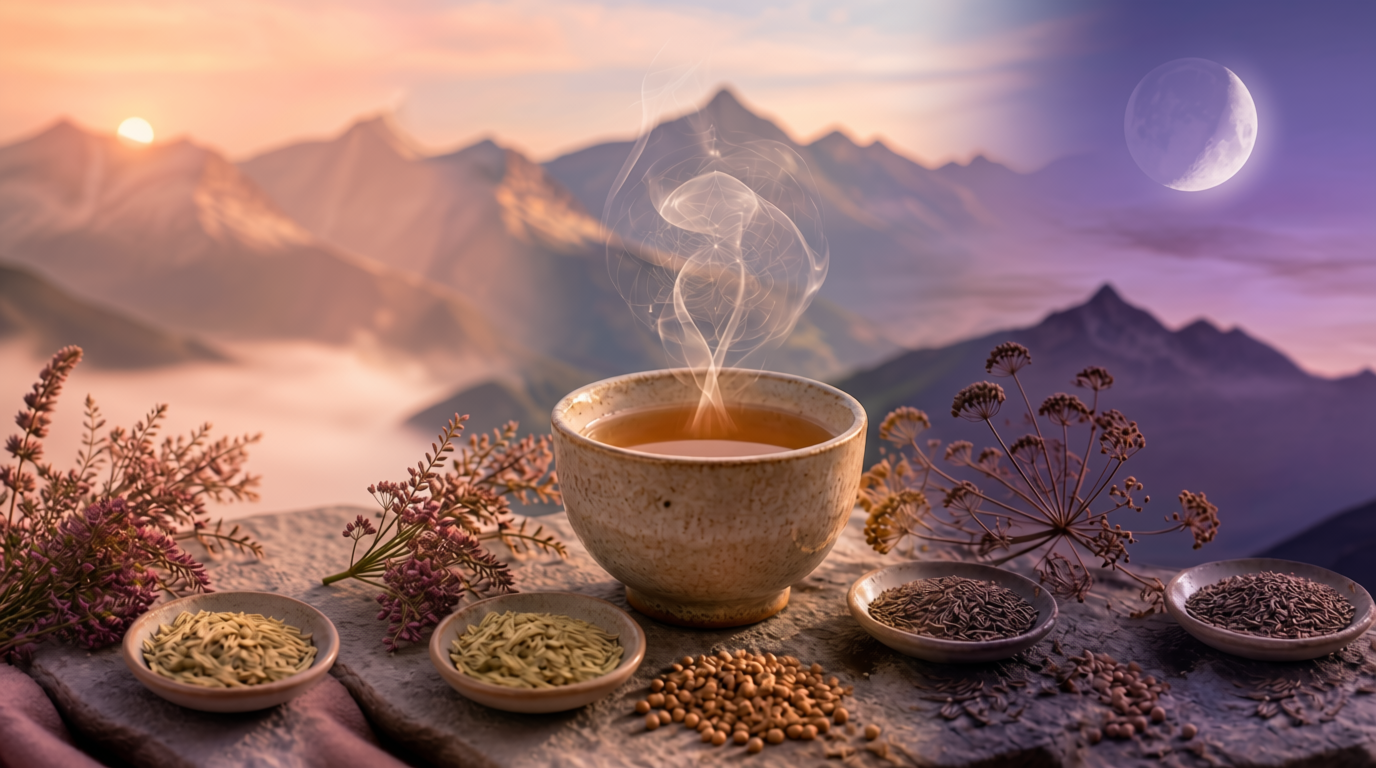
A tea built on three — three plants, three doshas, three sips of awareness; and the oldest rule in Ayurveda — like increases like, and opposites bring balance.
Late summer has a feeling. Clinging to the warmth and vibrancy of Summer, your body is craving the transition into Fall and rest. The heat has been going on long enough that it has accumulated as the element of fire, or Agni, in your body, also increasing Pitta Dosha in Ayurvedic terms. The short fuse, the flat energy at four in the afternoon, skin that's irritated, sleep that won't settle. Nothing is broken. This is simply what a body does at the end of a hot season when it can’t resolve the excess Fire, or Agni.
Nature has its own process to expel heat. Soon the leaves will express that excess Pitta in bright colors of orange, yellow, and red. Drying out completely, the trees will shed that weight and heat until the first big wind of winter, Vata Season, blows away all the leaves and the last bit of warmth.
The nature in our body is no different.
And there is a beautifully simple law underneath it.
Like increases like
Ayurveda calls it Samanya and Vishesha — similarity and difference. Whatever quality you add more of, you get more of. Whatever opposite quality you add, you begin to balance.
Hot season + hot food + a hot pace = more heat. That's Samanya at work, and it's why late summer feels the way it does.
Cool, sweet, slow, moist = balance. That's Vishesha — and it is the entire strategy for these next few weeks.
This is what makes Ayurveda a practice rather than a rulebook. You are not following a protocol. You are noticing which extreme you're living in and walking back toward the middle with awareness.
Why three
Three is not an accident here. Three is the number that makes creation possible — the triangle, the first shape that can hold space; the trinity in every tradition that has one; the three doshas; the three-part Om (A-U-M) that resolves into silence.
Three plants. Cumin, coriander, fennel. One kindles, one cools, one sweetens.
Three qualities to add right now. Cool, sweet, slow.
Three breaths before the first sip. Aroma is the fastest route into the nervous system there is. Give it three breaths, and the tea starts working before it reaches your mouth.
Plants are a vibration before they are chemistry. Each one carries a frequency, an intelligence, a particular quality it keeps offering to our world, our body, and our minds. We commune with these plants when we brew them, name them, and drink them with intention. You are not just consuming a substance — you are entraining yourself to that quality and resonating with the frequency of that plant. That is what a Mantra does too. (Hint to the name of my business, Mantra Mama) Same principle, different medium.
Signs you're carrying extra heat
Irritability, impatience, a shorter fuse than usual
Skin flare-ups, rashes, redness, dry-flakey skin
Acid reflux, loose and/or burning stools, or digestion that feels burnt out, not digesting foods
Waking hot at 2 a.m., or trouble falling asleep at all
Driven and busy, but running on empty
Why late summer is the moment
The translation of Dosha in Sanskrit actually refers to what is present in excess. So Pitt Dosha it calling to to the heat or Agni that has been quietly building in your body and mind through the season. It shows up as symptoms later in the physiology and behaviors when we have not counterbalanced the qualities of Summer or Pitta— hot, dry, oily, and sharp.
Then fall arrives with its own opposite qualities: dry, light, cold, moving, irregular. Meeting that dryness while you're still hot and depleted is a rough transition. Meeting it cooled, moist, and steady is a completely different approach to Autumn.
So these weeks are the seam. Cool the heat, soothe your digestion, slow the pace, and let the season change gradually rather than all at once.
The Three Seeds
Cumin, coriander, and fennel — CCF — is one of Ayurveda's most common household teas, traditionally considered gentle enough for all three constitutions or Doshas.2 Each seed brings a quality, and the three together do what none does alone.
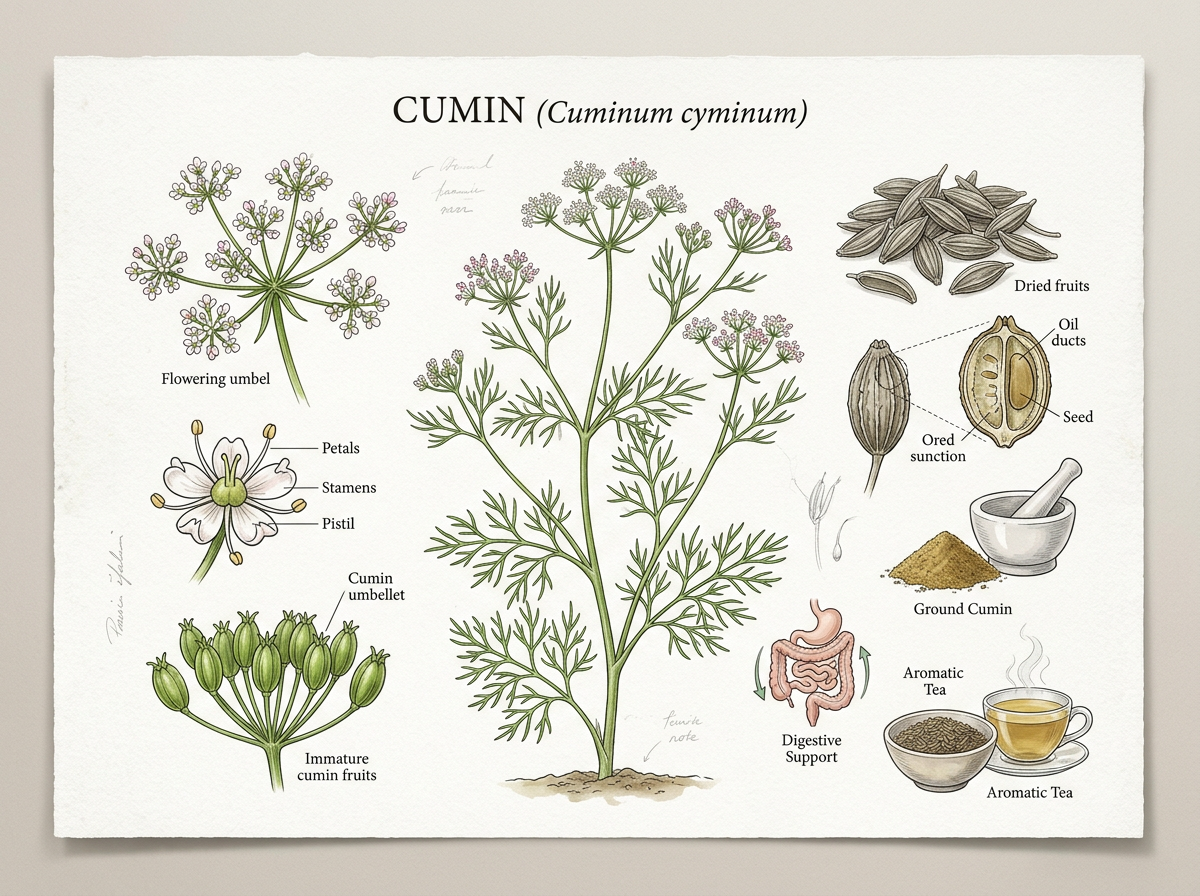
Cumin — Jeera — Cuminum cyminum
The mantra: Cumin teaches efficiency. Work smarter, not harder. Find the ease in your routine and practices and soften through this seasonal transition.
The quality: It wakes up digestion. Teachers actually disagree on whether cumin is cooling or slightly warming2,3 — which is exactly why it's used in a blend, with two cooling partners to keep it in balance.
Doshas: Stimulates Vata + Kapha
What research adds: Cumin has been studied most for steadying blood sugar, where pooled human trials show real reductions4 — a modern echo of what Ayurveda means by kindling digestion: the body metabolizes instead of storing. A 2024 hospital trial also tested it for getting sluggish bowels moving again after surgery.5
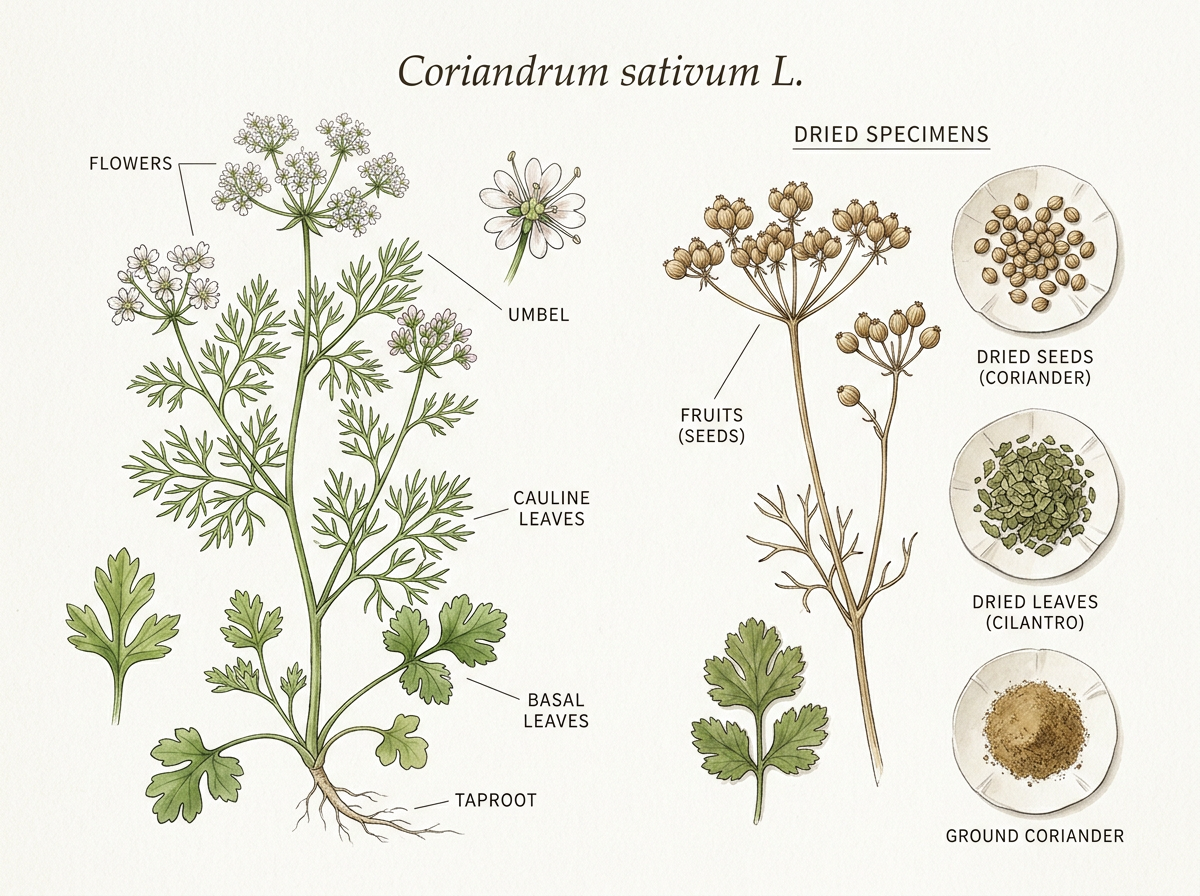
Coriander — Dhanya — Coriandrum sativum
The mantra: Coriandrum sativum. The clearer. It washes away what you no longer need and makes space for what's coming — which is exactly what a body needs at the end of a season.
The quality: the cooling one. Colder in energy than cumin, traditionally used for digestion, skin, and the urinary tract — the three places heat tends to show up first.2
Doshas: Soothes Pitta
What research adds: coriander's main aromatic compound is the same one that makes lavender calming, and lab studies consistently find it settling and anti-irritant.6 That work is still in cells and animals, not people — so treat it as support for the tradition, not proof.
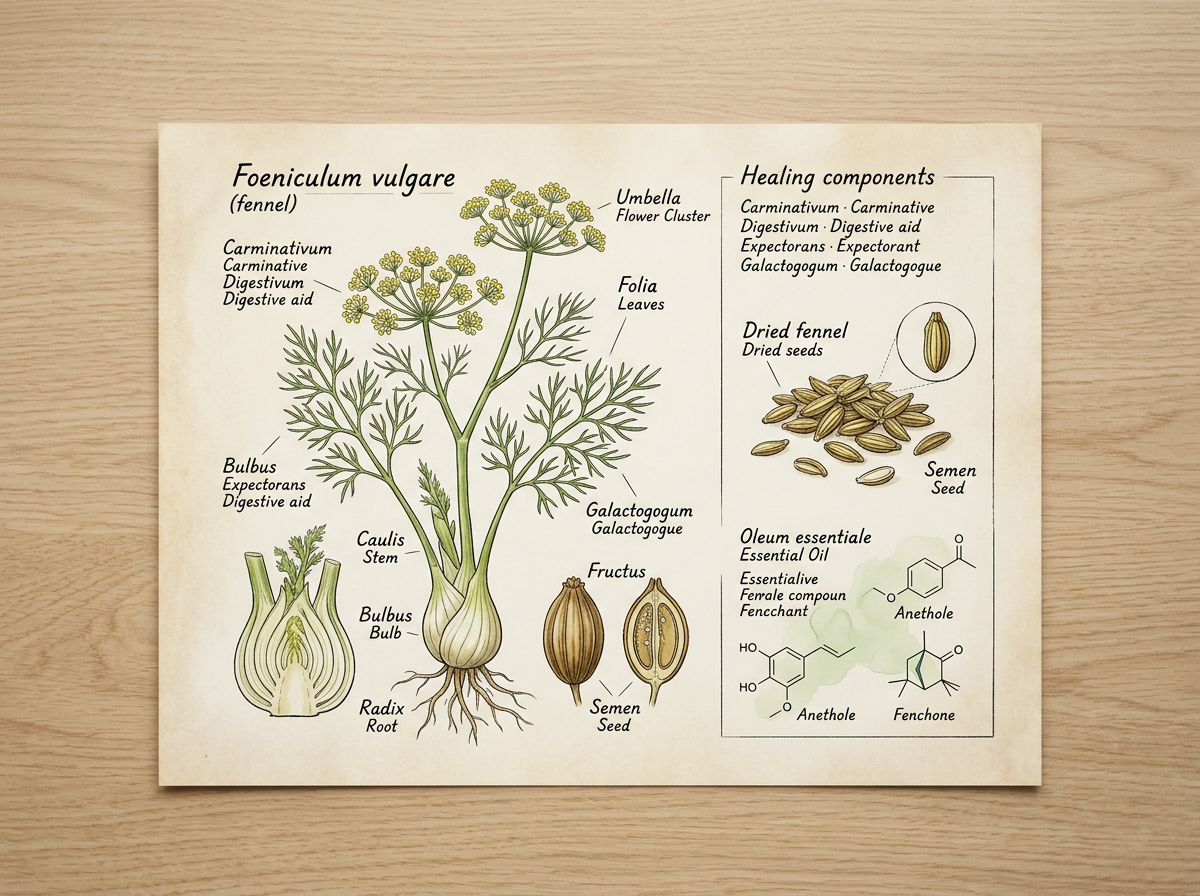
Fennel — Saunf — Foeniculum vulgare
The mantra: Foeniculum vulgare. The sweet teacher. Sweetness and ease are medicine too, and this is the seed that proves it.
The quality: Sweet, moistening, gently cooling — the taste Pitta craves as summer breaks, and the one that suits both Pitta and the dryness of Vata coming next.2
Doshas: Balances Pitta + Vata
What research adds: fennel's aromatic oil relaxes the muscle of the gut wall — a 2025 study of brewed fennel tea found it softens tension in the upper stomach while encouraging the lower part to keep moving things along.7 Relaxed above, moving below. That is very close to how Ayurveda describes sweet and unctuous qualities working on a tight, dry, overheated gut.
The gut, the mind, and clear awareness
This is the part that makes the tea more than a digestive remedy. The same nerves and chemistry run both ways through the gut-brain axis, so intestinal discomfort and mood move together.8 Balancing the irritability in the gut directly calms and soothes the mind in suit.
Ayurveda has always started here. Strong, calm digestion produces clarity; poor digestion produces heaviness, agitation, and dull thinking. We are literally decoding nature to support our bodies through our diet, which consists of all the five senses — not just food. The inability to digest that which is received through the senses creates confusion and imbalance in the body. So if the digestive system cannot break down foods, the body and mind become cluttered and muddled from that inability to process what it has taken in.
Lack of clarity and energy leads to lack of growth and human potential. So taking the time to elevate your senses and process things better through our digestive system is key to living a full life.
So a cup of tea is not a small thing. It is one of the places where physiology and consciousness meet.
How to make it
Source well. Organic, sustainably grown seed — cumin, coriander, and fennel in equal parts. The plant's medicine depends on how it was grown.
Roast fresh, grind fresh. Dry-roast the seeds briefly on low heat until fragrant, then grind. This is what opens the aromatic oils — the active part of the plant. Pre-ground powder has already lost most of it.
Just-boiled water. Roughly half a teaspoon of the blend per cup. Cover it and let it sit five minutes so the volatile oils stay in the cup instead of leaving with the steam.
Then slow down. Three breaths over the cup. Name the three plants if you like:
Genus Species (Latin Names):
Cuminum cyminum
Coriandrum sativum
Foeniculum vulgare
Or Sanskrit Names:
Jeera
Dhanya
Snauf
— Then three slow sips before you settle in. The pause is not decoration; it is the part most people skip, and the part that changes how you eat next.
When to drink it
Afternoon, on its own. The classic. Best in the heat of the day, when cooling is the whole point.
Morning, with fresh ginger. When digestion feels heavy or slow on waking and needs a little spark.
Early evening, with triphala. After dinner, as a digestive tea that helps you finish the day clean.
Morning, with ghee or coconut oil and milkn (coconut is my fav). Sweet, unctuous, coating — for dryness, and for the days you need to be held rather than stimulated.
What it actually does
Digestion and elimination. Less bloating and gas, better motility, and — this is the one I notice most in myself — better moisture in the gut rather than dryness.
Gentle diuretic effect. Real, and noticeable. I can attest to it. It's also why I don't drink it right before bed.
Calm, clarity, ground. As a high Pitta‑Vata type, this is what keeps me steady: cool without being scattered, clear without being wired.
A daily ritual. Caffeine-free, warm, at the same hour. Never underestimate what that alone does to a nervous system.
What it is not: a treatment for a diagnosed condition.
Talk to your doctor before drinking this if you
are pregnant or breastfeeding — fennel acts a little like estrogen in the body, so daily medicinal amounts are a different question than fennel in your cooking;
have a hormone-sensitive condition — same reason;
take a blood thinner — fennel can add to its effect;
take antibiotics — fennel can get in the way of how some of them are absorbed, so space them apart;
take medication for blood sugar — cumin lowers it too, which is good news and a reason to watch your numbers;
react to celery, carrot, or parsley — all three seeds come from that same plant family, so the allergy can carry over.
These statements have not been evaluated by the Food and Drug Administration. This tea is not intended to diagnose, treat, cure, or prevent any disease. This article is education, not medical advice.
If you want to go further
A tea is a starting point to balance your Doshas and your digestion, not a full personalized-individual plan for wellness both in body and mind. If you want to discover and balance your own Doshas, Prakriti — constitution, your current state of digestion/state of mind, and how you personally move through seasonal change, that's the work I do one-to-one as an Integrative Ayurvedic Health Counselor. Blending in Yoga Asana (postures), movement, philosophy, Reiki — energy clearing and healing, along with my knowledge of the laws of nature as they pertain to the body’s anatomy and subtle energy systems.
CCF Tea Samples Below

Receive 3 tea bag samples of all three CCF Teas for $5.
Morning CCF: Cumin, Coriander, Fennel, and a small amount of Ginger. Great if digestion is a little slow to start one summer day and when transitioning into the fall. More balancing for Vatas and Kaphas.
Regular CCF: Cumin, Coriander, & Fennel, the trio used in summer to stimulate, yet soothe digestion from heat during High Pitta Season.
Night-time CCF: Cumin, Coriander, Fennel, & Triphala, the classic digestive recommended for a healthy gut, combine with the soothing properties of CCF. Triodoshic balance.
Organic, Freshly Roasted, and ground Herbs, Spices, and Seeds sustainably traced to small farms.
When you heal yourself, you heal the world.
Jai Guru Dev
— Mantra Mama Wellness
Sources
Seasonal regimen and the build-up of Pitta through summer and the rains, flaring in early autumn — Charaka Samhita, Tasyashiteeya Adhyaya (carakasamhitaonline.com) and Easy Ayurveda.
Traditional energetics of the three seeds and CCF as a tea for all constitutions — Pure Indian Foods, "A Classic Ayurvedic Tea: Cumin, Coriander, Fennel."
Cumin described as slightly heating, balanced by the other two — Kripalu Center, "CCF: Ayurveda's Miracle Tea."
Cumin and blood sugar — systematic review and meta-analysis of controlled clinical trials, Journal of Ethnopharmacology (2021). Abstract. Note: these trials used concentrated extracts, not tea.
Cumin extract and the return of bowel movement after abdominal surgery — triple-blind randomised trial, 74 patients, BMC Complementary Medicine and Therapies (2024). Study.
Coriander and its calming aromatic compound, linalool — review of laboratory and animal studies. PMC8554282.
Brewed fennel tea relaxes the upper stomach while promoting movement lower down — Annaházi et al., Neurogastroenterology & Motility (2025). Study. The authors note human evidence for fennel is still thin.
Gut–brain interaction as established clinical language, including herbal approaches such as fennel — narrative review, Nutrients (2024). PMC10856962.
Fennel's estrogen-like activity, pregnancy caution, and celery/carrot cross-reactivity — Medical News Today; drug interactions with blood thinners and some antibiotics — Medscape drug reference.